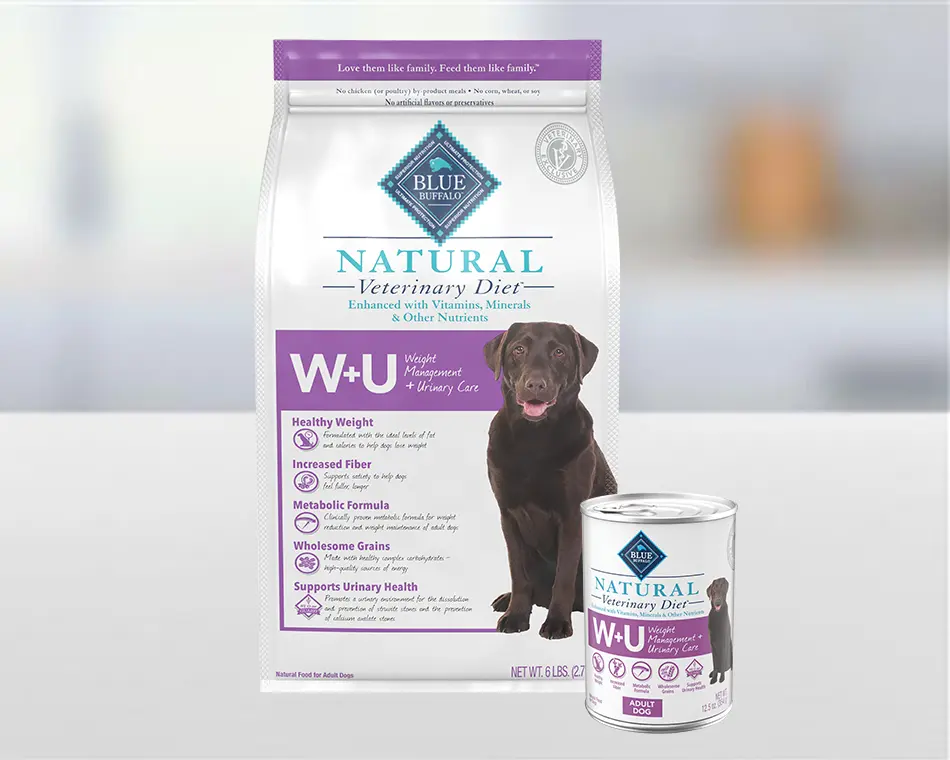
BLUE Natural Veterinary Diet™
Canine W+U Weight Management + Urinary Care
Provides nutritional support for urinary care and/or weight loss (a common issue in urinary patients), as well as weight maintenance once target body weight is achieved.
Features for Weight Management:
- Clinically proven nutrition to reduce body fat by 37.5% and body weight by 16.3% in just two months11
- L-carnitine to decrease body fat and maintain lean muscle12
- Betaine to support fat oxidation12
- High in mixed fiber sources such as brown rice, barley, tomato pomace, oatmeal and chicory root to promote satiety and promote weight loss
- Clinically proven nutrition to lower serum insulin and leptin levels with weight loss11
Features for Urinary Care:

- Formulated to dissolve and prevent struvite urolithiasis and prevent calcium oxalate urolithiasis7
- Clinically proven nutrition to generate a urine a pH of 6.0-6.488
- Controlled magnesium, sodium, and other mineral levels to limit urolith formation9
Indications
Weight Loss
- Weight management for obese or overweight dogs
- Helps to maintain lean muscle mass
- Weight maintenance for dogs that need to prevent weight gain
Urinary Care
- Dogs prone to lower urinary tract disease
- Helps to limit the formation of struvite uroliths
- Dissolution of pure struvite uroliths
- Helps to limit the formation of calcium oxalate urolithiasis
Nutritional Information
Animal feeding tests using AAFCO procedures substantiate that BLUE Natural Veterinary Diet™ W+U Weight Management + Urinary Care for Adult Dogs provides complete and balanced nutrition for adult maintenance.
Nutritional Analysis
| Nutrient | As-Fed (Average) |
Dry Matter Basis (Average) |
Per 100 kcals |
|---|---|---|---|
| Protein | 31.00% | 33.70% | 9.88 g |
| Crude Fat | 11.12% | 12.09% | 3.54 g |
| Carbohydrate (NFE) | 31.60% | 34.35% | 10.07 g |
| Crude Fiber | 13.50% | 14.67% | 4.30 g |
| Total Dietary Fiber | 21.16% | 23.00% | 6.74 g |
| Insoluble Fiber | 19.20% | 20.87% | 6.12 g |
| Soluble Fiber | 1.94% | 2.11% | 0.62 g |
| Ash | 5.70% | 6.20% | 1.82 g |
| Calcium | 0.90% | 0.98% | 0.29 g |
| Phosphorus | 0.62% | 0.67% | 0.20 g |
| Sodium | 0.22% | 0.24% | 0.07 g |
| Chloride | 0.70% | 0.76% | 0.22 g |
| Potassium | 0.88% | 0.96% | 0.28 g |
| Magnesium | 0.11% | 0.12% | 0.04 g |
| Iron | 217.00 mg/kg | 235.87 mg/kg | 6.92 mg |
| Copper | 20.50 mg/kg | 22.28 mg/kg | 0.65 mg |
| Manganese | 25.00 mg/kg | 27.17 mg/kg | 0.80 mg |
| Zinc | 183.60 mg/kg | 199.57 mg/kg | 5.85 mg |
| Iodine | 2.28 mg/kg | 2.48 mg/kg | 0.07 mg |
| Selenium | 0.58 mg/kg | 0.63 mg/kg | 0.02 mg |
| Omega-3 Fatty Acids | 0.79% | 0.86% | 0.25 g |
| Omega-6 Fatty Acids | 2.27% | 2.47% | 0.72 g |
| Linoleic Acid | 2.18% | 2.37% | 0.69 g |
| Arachidonic Acid | 0.06% | 0.07% | 0.02 g |
| Taurine | 0.40% | 0.43% | 0.13 g |
| L-Carnitine | 450.00 mg/kg | 489.13 mg/kg | 14.34 mg |
| Vitamin C | 8.04 mg/kg | 8.74 mg/kg | 0.26 mg |
| Vitamin E | 600.00 IU/kg | 652.17 IU/kg | 19.12 IU |
| Vitamin A | 25506.00 IU/kg | 27723.91 IU/kg | 812.81 IU |
| Vitamin D3 | 1360.00 IU/kg | 1478.26 IU/kg | 43.34 IU |
| Glucosamine | 271.30 mg/kg | 294.89 mg/kg | 8.65 mg |
| Chondroitin | 568.28 mg/kg | 617.70 mg/kg | 18.11 mg |

Metabolizable Energy
| kcal/cup | 314 |
| Grams/cup | 100 |
| kcal/kg (ME Calculated) | 3,123 |
Recommended Daily Feeding Chart for Adults
| Up to 15 lbs. | 1/4 – 1 1/4 cups* |
| 16 to 25 lbs. | 1 1/4 – 1 3/4 cups* |
| 26 to 40 lbs. | 1 3/4 – 2 1/2 cups* |
| 41 to 60 lbs. | 2 1/2 – 3 1/4 cups* |
| 61 to 80 lbs. | 3 1/4 – 4 cups* |
| 81 to 100 lbs. | 4 – 4 3/4 cups* |
| Over 100 lbs. | Feed 4 3/4 cups* plus 1/2 cup for each additional 20 lbs. |
| Up to 15 lbs. | 1/2 – 1 1/2 cups* |
| 16 to 25 lbs. | 1 1/2 – 2 1/4 cups* |
| 26 to 40 lbs. | 2 1/4 – 3 1/4 cups* |
| 41 to 60 lbs. | 3 1/4 – 4 1/4 cups* |
| 61 to 80 lbs. | 4 1/4 – 5 1/4 cups* |
| 81 to 100 lbs. | 5 1/4 – 6 1/4 cups* |
| Over 100 lbs. | Feed 6 1/4 cups* plus 1/2 cup for each additional 20 lbs. |
*Use a standard 8-oz. measuring cup.
Ingredients
Deboned Chicken, Chicken Meal, Brown Rice, Barley, Powdered Cellulose, Potato Protein, Dried Tomato Pomace, Natural Flavor, Oatmeal, Flaxseed (source of Omega-6 Fatty Acids), Salmon Meal (source of Omega-3 Fatty Acids), Chicken Fat (preserved with Mixed Tocopherols), Cranberries, Calcium Sulfate, Betaine Hydrochloride, Potassium Citrate, Choline Chloride, Potassium Chloride, Direct Dehydrated Alfalfa Pellets, Dried Chicory Root, Taurine, Alfalfa Nutrient Concentrate, DL-Methionine, Calcium Chloride, Calcium Carbonate, Vitamin E Supplement, Sweet Potatoes, Carrots, Salt, Zinc Amino Acid Chelate, L-Carnitine, preserved with Mixed Tocopherols, L-Threonine, L-Tryptophan, Iron Amino Acid Chelate, Garlic, Vegetable Juice for color, L-Ascorbyl-2-Polyphosphate (source of Vitamin C), Blueberries, Barley Grass, Parsley, Turmeric, Dried Kelp, Yucca Schidigera Extract, Copper Amino Acid Chelate, Manganese Amino Acide Chelate, Niacin (Vitamin B3), Calcium Pantothenate (Vitamin B5), L-Lysine, Biotin (Vitamin B7), Vitamin A Supplement, Zinc Sulfate, Ferrous Sulfate, Thiamine Mononitrate (Vitamin B1), Riboflavin (Vitamin B2), Vitamin D3 Supplement, Vitamin B12 Supplement, Pyridoxine Hydrochloride (Vitamin B6), Calcium Iodate, Dried Yeast, Dried Enterococcus faecium fermentation product, Dried Lactobacillus acidophilus fermentation product, Dried Aspergillus niger fermentation extract, Dried Trichoderma longibrachiatum fermentation extract, Dried Bacillus subtilis fermentation extract, Copper Sulfate, Folic Acid (Vitamin B9), Manganese Sulfate, Sodium Selenite, Oil of Rosemary.
BLUE Natural Veterinary Diet™ W+U Weight Management + Urinary Care is formulated to meet the nutritional levels established by the AAFCO Dog Food Nutrient Profiles for adult maintenance.
Nutritional Analysis
| Nutrient | As-Fed (Average) |
Dry Matter Basis (Average) |
Per 100 kcals |
|---|---|---|---|
| Crude Protein | 8.50% | 34.37% | 9.65 g |
| Crude Fat | 4.25% | 17.19% | 4.82 g |
| Carbohydrate (NFE) | 5.38% | 21.75% | 6.11 g |
| Crude Fiber | 3.12% | 12.62% | 3.54 g |
| Total Dietary Fiber | 3.99% | 16.13% | 4.53 g |
| Insoluble Fiber | 3.64% | 14.72% | 4.13 g |
| Soluble Fiber | 0.35% | 1.42% | 0.40 g |
| Ash | 2.33% | 9.42% | 2.64 g |
| Calcium | 0.46% | 1.86% | 0.52 g |
| Phosphorus | 0.37% | 1.50% | 0.42 g |
| Sodium | 0.13% | 0.53% | 0.15 g |
| Chloride | 0.21% | 0.85% | 0.24 g |
| Potassium | 0.29% | 1.17% | 0.33 g |
| Magnesium | 0.03% | 0.12% | 0.03 g |
| Iron | 59.1 mg/kg | 238.98 mg/kg | 6.71 mg |
| Copper | 6.11 mg/kg | 24.71 mg/kg | 0.69 mg |
| Manganese | 6.05 mg/kg | 24.46 mg/kg | 0.69 mg |
| Zinc | 48.7 mg/kg | 196.93 mg/kg | 5.70 mg |
| Iodine | 0.47 mg/kg | 1.90 mg/kg | 0.06 mg |
| Selenium | 0.19 mg/kg | 0.77 mg/kg | 0.02 mg |
| Omega-3 Fatty Acids | 0.18 % | 0.73 % | 0.21 g |
| DHA | 0.02% | 0.09 % | 0.03 g |
| EPA | 0.01 % | 0.04 % | 0.01 g |
| EPA + DHA | 0.03 % | 0.12 % | 0.04 g |
| Omega-6 Fatty Acids | 0.83 % | 3.36 % | 0.97 g |
| Linoleic Acid | 0.75 % | 3.03 % | 0.88 g |
| Arachidonic Acid | 0.07 % | 0.28 % | 0.08 g |
| Taurine | 0.14 % | 0.57 % | 0.16 g |
| L-Carnitine | 140.04 mg/kg | 566.28 mg/kg | 16.40 mg |
| Vitamin C | 84.00 mg/kg | 339.67 mg/kg | 9.84 mg |
| Vitamin E | 78.00 IU/kg | 315.41 IU/kg | 9.13 IU |
| Vitamin A | 36639.00 IU/kg | 148156.09 IU/kg | 4290.28 IU |
| Vitamin D3 | 428.00 IU/kg | 1730.69 IU/kg | 50.12 IU |
| Glucosamine | 143.00 mg/kg | 578.25 mg/kg | 16.74 mg |
| Chondroitin | 472.00 mg/kg | 1908.61 mg/kg | 55.27 mg |
Metabolizable Energy
| kcal/12.5 oz. can | 303 |
| Grams/12.5 oz. can | 354 |
| kcal/kg (ME Calculated) | 854 |
Recommended Daily Feeding Chart for Adults
| 10 to 30 lbs. | Feed 2/3 can per 10 lbs. of body weight per day. |
| 30 to 50 lbs. | Feed 1/2 can per 10 lbs. of body weight per day. |
| Over 50 lbs. | Feed 3/8 can per 10 lbs. of body weight per day. |
| Under 30 lbs. | Feed 1 can per 10 lbs. of body weight per day. |
| Over 30 lbs. | Feed 2/3 can per 10 lbs. of body weight per day. |
Refrigerate unused portion.
Ingredients
Chicken, Chicken Broth, Water, Whitefish, Chicken Liver, Carrots, Powdered Cellulose, Potatoes, Barley, Dried Plain Beet Pulp, Dried Egg Product, Brown Rice, Oats, Flaxseed, Natural Flavor, Sodium Acid Pyrophosphate, Potassium Chloride, Betaine Anhydrous, Carrageenan, Blueberries, Cranberries, Taurine, Guar Gum, Calcium Sulfate, Choline Chloride, DLMethionine, L-Carnitine, L-Ascorbyl-2-Polyphosphate (source of Vitamin C), Zinc Amino Acid Chelate, Iron Amino Acid Chelate, Vitamin E Supplement, Salt, Copper Amino Acid Chelate, Manganese Amino Acid Chelate, Sodium Selenite, Thiamine Mononitrate (Vitamin B1), Cobalt Amino Acid Chelate, Niacin Supplement (Vitamin B3), Calcium Pantothenate (Vitamin B5), Vitamin A Supplement, Riboflavin Supplement (Vitamin B2), Biotin (Vitamin B7), Vitamin B12 Supplement, Potassium Iodide, Pyridoxine Hydrochloride (Vitamin B6), Vitamin D3 Supplement, Folic Acid (Vitamin B9).
BLUE Clinical Data
BLUE Clinical Data
Urine Relative Supersaturation (RSS) Evaluation


Purpose
To show that feeding BLUE Natural Veterinary Diet W+U Weight Management + Urinary Care food, which contains controlled levels of magnesium and sodium as well as controlled pH levels, can result in clinically significant urine RSS values less than 1 for struvite and less than 5 for calcium oxalate. These RSS values have been shown to limit the formation of struvite and calcium oxalate uroliths.

Study Design
Two groups of adult dogs (n=10 each for Canine RSS Studies 1 and 2) and 2 groups of adult cats (n=10 each for Feline RSS Studies 1 and 2) were enrolled in the studies. All animals selected were clinically healthy. Animals were maintained in standard, species-appropriate housing and managed consistently during the study, including providing access to activity/exercise. The study protocols were reviewed and approved by the research facility’s institutional animal care and use committee.
Animals were fed the species-appropriate dry BLUE Natural Veterinary Diet W+U food for 23 days. An amount of food calculated to maintain body weight was offered once daily and available for 1 hour for dogs and for 20 hours for cats.
On day 22, a 24-hour urine sample was collected from each animal, using a metabolism cage with a urine collection system for dogs and a specialized litter box for cats. From that sample, urine pH was measured via pH meter and 2 aliquots were frozen and shipped to The University of Tennessee for RSS analysis.17 Those aliquots included a 1-ml sample that was diluted with 1.5 ml 1N HCl, and a 10- to 15-ml sample placed in a sterile container. For the RSS analysis, urine sodium, potassium, chloride, calcium, magnesium, phosphorus, citrate, oxalate, ammonia, pH, creatinine, and uric acid were measured.

Results18
Feeding dry BLUE Natural Veterinary Diet W+U food in both dog and cat studies resulted in clinically proven urine RSS values <1 for struvite and <5 for calcium oxalate.
Study: Urine pH Studies

Purpose
To show that feeding BLUE Natural Veterinary Diet W+U Weight Management + Urinary Care food can consistently produce a urine pH of 6.0-6.4, which includes the recommended urine pH ranges to prevent struvite urolithiasis in dogs (6.2-6.4) and cats (6.0-6.4.)
Study Design
Two groups of adult dogs (n=8 each for Canine Urine pH Studies 1 and 2) and 2 groups of adult cats (n=8 each for Feline Urine pH Studies 1 and 2) were enrolled in the studies. All animals selected were clinically healthy. Animals were maintained in metabolism cages during the study. Animals were fed the species-appropriate dry BLUE Natural Veterinary Diet W+U food for 5 days. An amount of food calculated to maintain body weight was offered once daily and available for 2 hours. On day 5, urine samples were collected from each animal at 0, 4, 8, and 24 hours via cystocentesis for measurement of pH.
Results18/Clinical Impact
Overall, feeding BLUE Natural Veterinary Diet W+U food in both dog and cat studies resulted in mean urine pH values between 6.0 and 6.2.
The results of the studies discussed in this Clinical Report support BLUE Natural Veterinary Diet W+U food as clinically proven to produce a urinary pH value of 6.0-6.4 to prevent struvite urolithiasis in dogs and cats. Additionally, by producing a Struvite RSS of <1 to help limit the formation of struvite uroliths and to produce a Calcium Oxalate RSS of <5 to reduce the risk of development and reoccurrence of calcium oxalate uroliths, BLUE Natural Veterinary Diet W+U food can support the urinary health of dogs and cats.
Disease State Education
Urolithiasis is a common disorder of the urinary tract in dogs and cats. Uroliths can form in urine anywhere along the urinary tract from the kidneys to the tip of the urethra causing irritation, infection, pain, and/or obstruction.

The most common canine uroliths are calcium oxalate, magnesium ammonium phosphate (struvite), or mixed.1 The most common feline uroliths are magnesium ammonium phosphate, calcium oxalate and mixed.2, 3
Certain diets, supplements or metabolic conditions can lead to high mineral concentrations in the urine, and potentially stone and/or crystal formation. Urinary pH also influences formation of several crystal types. Although exceptions occur, crystal types tend to form and persist at certain urinary pH ranges. In general, struvite uroliths are associated with more alkaline urinary pH values (>6.4) and calcium oxalate uroliths are associated with lower urinary pH values.4, 5, 6
In most cases, struvite uroliths form in association with urinary tract infections with urease-producing bacteria (often Staphylococcus spp., Proteus spp.)7, 8 Sterile struvite uroliths rarely form in dogs. The bacteria utilize urea in the urine to form ammonia and carbon dioxide. The ammonia is changed to ammonium, which, in turn, raises the urine pH and becomes available for the formation of magnesium ammonium phosphate crystals (struvite). As the urine pH increases, phosphate becomes more available to contribute to struvite crystal formation and struvite becomes less soluble. As the urine concentrations of phosphate, magnesium, and ammonium rise, supersaturation of the urine occurs, contributing to crystal and urolith formation.9, 10
Feline urolithiasis is a common disease seen with equal frequency in both sexes. Until recently, it was thought that most uroliths in cats were small and resembled sand or were gelatinous plugs that differed from typical uroliths in that they contained a greater amount of organic matrix, giving them a toothpaste-like consistency.8 Matrix-crystalline plugs are most commonly found within the urethra near the urethral orifice and are primarily responsible for urethral obstruction. Recently, prevalence of urolithiasis with grossly observable stones composed primarily of calcium oxalate has increased in cats.3, 11
Optimal Nutrition For Urinary Support
Relative Supersaturation (RSS) evaluation has been the gold standard for urine assessment in humans for decades and has been proven to be the only reliable predictor of the risk of calcium oxalate urolithiasis.12, 13 This methodology involves the analysis of 12 constituents of a collected urine sample, as well as the determination of urine pH. These data are then analyzed using a computer program that calculates the concentrations of the large number of interactive complexes between all ions present in this urine. Finally, the program calculates the activity product of the urine sample for a given urolith and divides this number by the known constant thermodynamic solubility product for that urolith to determine RSS. Urine below the solubility product for a given salt is termed undersaturated. If urine is maintained within this zone uroliths cannot form. Regardless of the stone type (i.e struvite, calcium oxalate, etc.) undersaturated urine will have an RSS <1. Any existing struvite crystals or uroliths added to urine in this state will dissolve. Although it is not possible to dissolve pre-existing calcium oxalate, they will not grow or reform in pre-disposed animals in this environment.14 RSS is a single value that can be used to describe the efficacy of a given diet in managing urolithiasis in dogs and cats.
RSS testing has shown that it is possible for a single diet to manage both types of uroliths (RSS <1 for struvite and RSS <5 for calcium oxalate) (see Figure 2) and that it is possible to undersaturate for calcium oxalate with an acidifying diet.12
References
-
- Lulich JP, Osborne CA. Canine urolith epidemiology: 1981-2010. DVM360 Magazine July 1, 2011Available at: http://veterinarynews.dvm360.com/canine-urolith-epidemiology-1981-2010.
- Lulich JP, Osborne CA, Nwaokorie E. Feline urolith epidemiology update: 1981-2011. DVM360 Magazine July 1, 2012 Available at: http://veterinarynews.dvm360.com/feline-urolith-epidemiology-update-1981-2011.
- Houston DM and Moore AEP. Canine and feline urolithiasis: examination of over 50,000 urolith submissions to the Canadian Veterinary Urolith Centre from 1998 to 2008. Canadian Veterinary Journal. 2009;50:1263-1268.
- Osborne CA, Kruger JM, Lulich JP, et al. Disorders of the feline lower urinary tract. In: Osborne CA, Finco DR, eds. Canine and Feline Nephrology and Urology. Baltimore, MD: Williams & Wilkins, 1995; 651.
- Osborne CA et al. Canine struvite urolithiasis: Causes, detection, management and prevention. In: Hand M et al. Small Animal Clinical Nutrition. 5th ed. Topeka, KS: Mark Morris Institute, 2010: 891-914.
- Forrester SD, Kruger JM, Allen TA. Feline lower urinary tract diseases. In: Hand M et al. Small Animal Clinical Nutrition. 5th ed. Topeka, KS: Mark Morris Institute, 2010: 925-976.
- Adams LG, Syme HM. Canine lower urinary tract diseases. In: Ettinger SJ, Feldman EC, eds. Textbook of Veterinary Internal Medicine. 6th ed. St. Louis, Mo: Elsevier Saunders, 2005;1850-1874.
- Westropp JL, Buffington CAT, Chew DJ, et al. Feline lower urinary tract diseases. In: Ettinger SJ, Feldman EC, eds. Textbook of Veterinary Internal Medicine. 6th ed. St. Louis, Mo: Elsevier Saunders, 2005;1828-1850.
- Osborne CA, Lulich JP, Polzin DJ, et al. Medical dissolution and prevention of canine struvite urolithiasis, twenty years of experience. Vet Clin North Am Small Anim Pract. 1999;29:73–111.
- Seaman R, Bartges JW. Canine struvite urolithiasis. Compend Contin Educ Pract Vet. 2001;23:407–420.
- Cannon AB, Westropp JL, Ruby AL, et al. Evaluation of trends in urolith composition in cats: 5,230 cases (1985-2004). J Am Vet Med Assoc 2007;231(4):570-576.
- Smith, B.H.E., Stevenson, A.E., Markwell, P.J. Effect of diet on relative supersaturations in feline urine. Proceedings of the FECAVA Congress, 1995; 350-360.
- Smith, B. H. E., Stevenson, A. E., Markwell, P. J., Urinary relative supersaturations of calcium oxalate and struvite in cats are influenced by diet. Journal of Nutrition 1998; 128: 2763S–2764S.
- Stevenson, A. E., Wrigglesworth, D. J., Markwell, P. J. Urine pH and urinary relative supersaturations in healthy adult cats. Proceedings of the 9th International Symposium; 2000: 818-820.
- Stevenson A. & Rutgers C. Nutritional Management of Canine Urolithiasis. In:Encyclopedia of Canine Clinical Nutrition. Eds: Pibot P, Biourge V. Elliott D. 2006. Aniwa SAS. Pgs 284-315.
- Bartges, Joesph W., et al. Methods of Evaluating treatment of Uroliths. Veterinary Clinics of North America: Small Animal Practice 1999;29:46.
- University of Tennessee Pharmacology Lab, College of Veterinary Medicine.
- Blue Buffalo Co., Ltd., data on file, 2015.
- Blue Buffalo Co., Ltd., Consumer Studies, July and December 2015.


